Security Is a Feature
AI tools made the web cheaper to attack and more expensive to run. Here is how we keep client sites fast, safe, and unbothered by the bots quietly running up the bill.
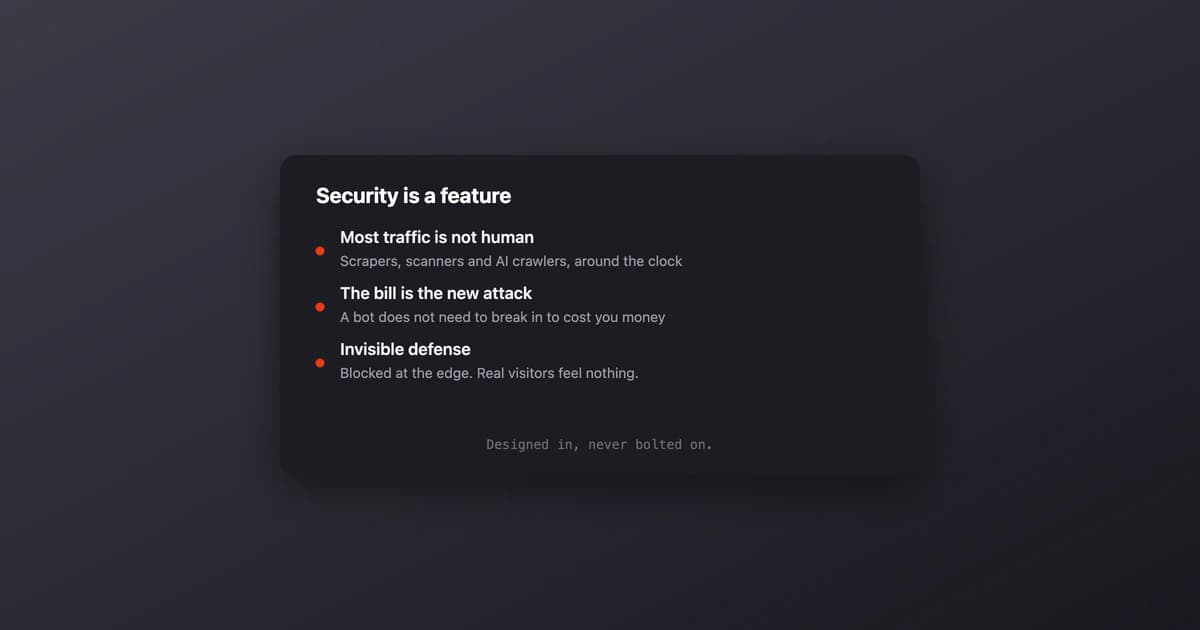
Open your analytics and a flattering story stares back: every line looks like a person who chose to visit you. Most of them are not. A large and growing share of the traffic hitting any modern website is automated. Scrapers, vulnerability scanners, price bots, and a new generation of AI crawlers that copy everything they can reach. Most never buy a thing. Some are quietly checking whether your front door is locked.
The AI boom pushed this both ways at once. It handed everyone cheap tools to probe and scrape at scale, and it created a bottomless hunger for content to feed models. The web is now cheaper to attack and more expensive to run. We build for both, on every site we ship.
Security is not something you sprinkle on at the end. It is a property of how the thing was built. We treat it like speed: designed in, never bolted on.
The bill is the new attack
Here is the part nobody warns you about: you do not have to be hacked to get hurt. Modern sites run on metered infrastructure, where every request, every image, and every function that wakes up carries a price. Point a hungry crawler at an unprotected site and it will cheerfully run the bill somewhere you never budgeted for, while your real visitors notice nothing.
So we are strict about resources. We cache hard, so one page is not rebuilt a thousand times for a thousand bots. We serve right-sized modern images, so nobody drains a month of bandwidth hammering a folder of heavy files. We throttle the endpoints that actually cost money, like forms and search. A bad actor should hit a wall long before it hits your invoice.
Block the parasites, keep the guests
The lazy way to stop scrapers is to slam the door on anything without a mouse and a heartbeat. That also slams the door on Google, on the AI assistants that now recommend businesses to real people, and sometimes on your own customers. We do not do lazy.
Instead we separate the traffic we want from the traffic we do not. Search engines and the AI tools that send real visitors get a clean, fast, fully readable site, because being found is the entire point. The extractive bots that take everything and give nothing back meet rate limits and quiet dead ends, at the edge, before a page is ever built. The defense stays invisible and costs your real visitors exactly zero milliseconds.
A scraper should never know it lost. The page just gets slow, then boring, then gone. The human reading this never feels a thing.
We wrote ourselves a playbook
None of this should be improvised project by project, so we wrote it down. A security playbook we run on every build: the headers that lock a site down, the rules that keep secrets out of the browser, the database policies that assume the worst, and the bot defenses above. It turns security from something we hope we remembered into something the site simply is.
Most of it you will never see, which is exactly the point. A safe website does not look safe. It looks fast, it works, and it quietly refuses to become someone else's free lunch. That is the job. Lately, it is most of the job.