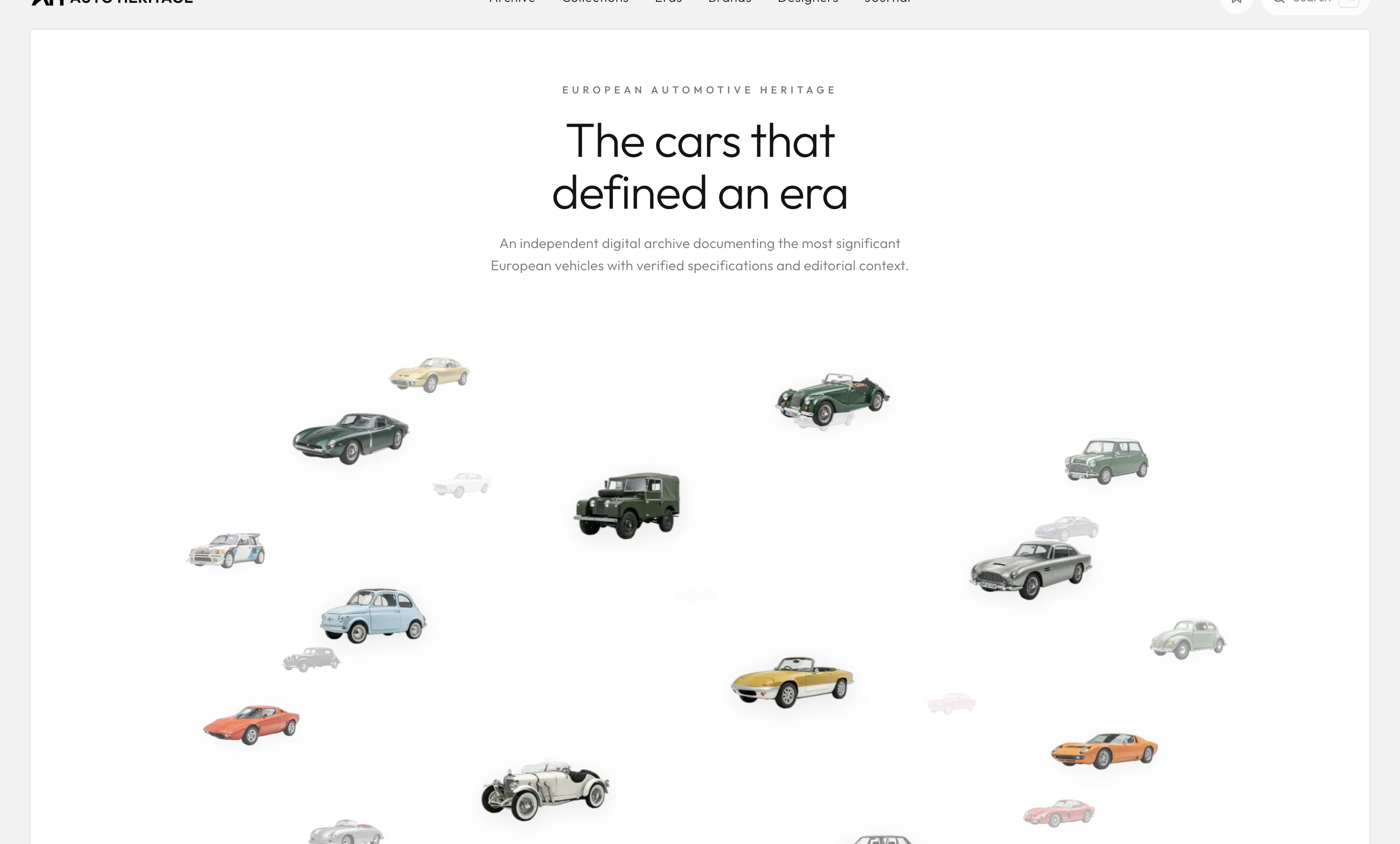





The Brief: Preserving Automotive Heritage
Displace Agency built autoheritage.eu for ECAH (European Contemporary Automotive Heritage), a non-profit association preserving European automotive history. The platform is a custom Next.js 16 and Supabase application hosting 175 fully documented vehicles, 17 journal articles, and cross-referenced editorial content. We chose headless architecture over Webflow because the project required complex data relationships between vehicles, brands, eras, and articles, plus programmatic SEO page generation from database records.
The association was already established as a non-profit, with deep connections to the European collector community. What they lacked was the digital infrastructure to house their growing archive of vehicles, editorial content, and the ambition to become the go-to resource for automotive heritage.
This was not a typical Displace project. The scope demanded a custom-built platform, not a Webflow site.
By the numbers
175
Vehicles documented
17
Editorial articles
3
Heritage verticals
<2s
Page load time
Why We Chose Next.js + Supabase Over Webflow
While we build most client websites on Webflow, Auto Heritage demanded something different. The platform needed to handle a database of 400+ vehicles with rich metadata, cross-referenced editorial content, programmatic SEO pages, and an architecture built for scale.
We chose Next.js 16 with TypeScript and Tailwind CSS v4 for the frontend. For the backend, Supabase gave us a PostgreSQL database with real-time capabilities, row-level security, and a management API that could power the content pipeline without a traditional CMS.
Side by side
Webflow
Next.js + Supabase
- Server-side rendering for SEO performance
- Static generation for speed (sub-2-second loads)
- Complex data relationships between vehicles, articles, brands, and eras
- Programmatic page generation from database records
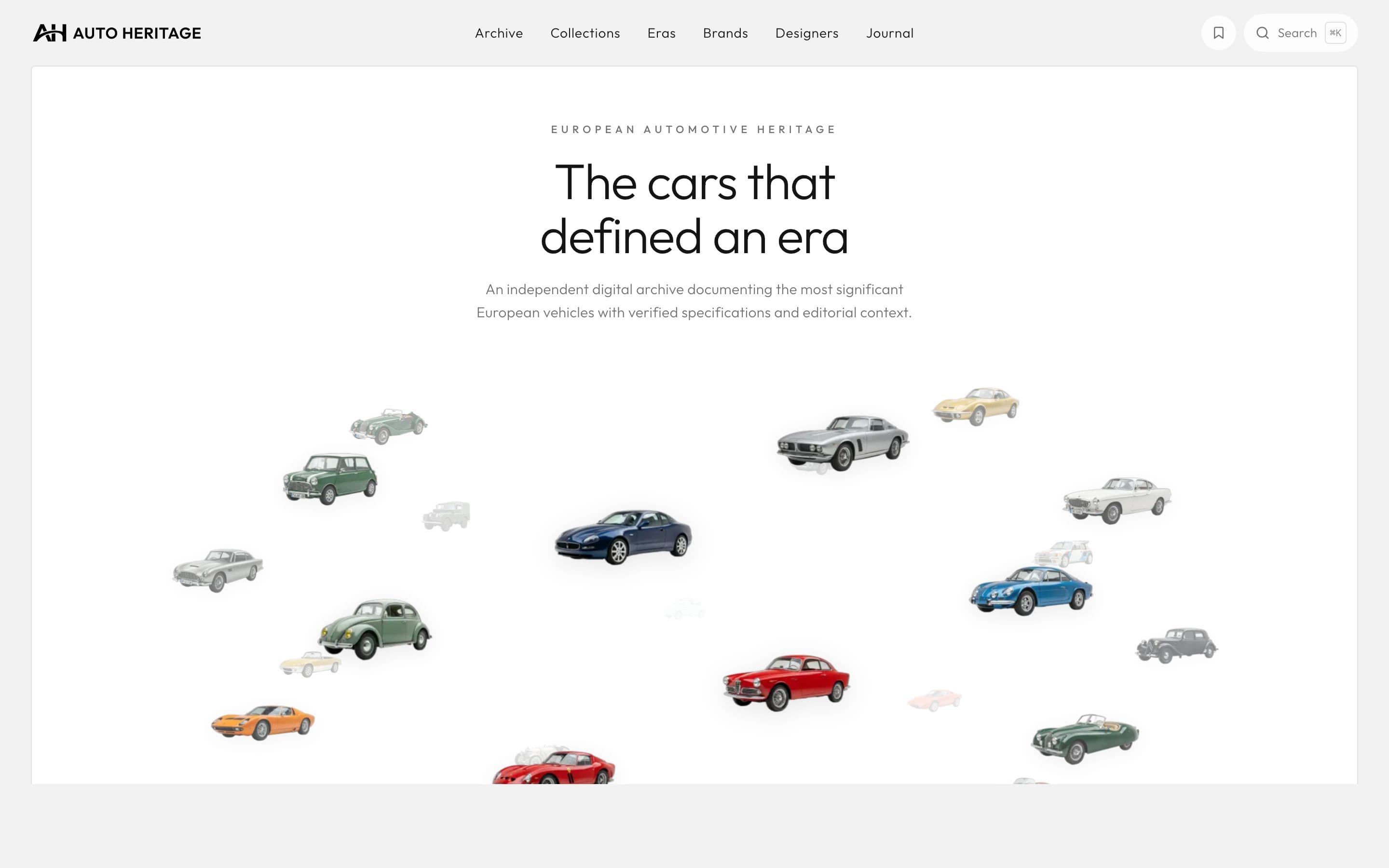
The Vehicle Archive: 175 Cars and Counting
The core of the platform is the vehicle archive. Each vehicle entry includes make, model, year, country of origin, production numbers, engine specifications, and historical significance. Every vehicle is cross-referenced with related articles and linked to its brand's heritage page.
We built a data pipeline that ingests vehicle information from curated spreadsheets, validates the data against our schema, and publishes to Supabase. Images are processed and served through our CDN at cdn.displace.agency, optimized for fast loading with AVIF format and responsive srcsets.
At launch, the archive featured 175 vehicles with full imagery, with another 292 in the database awaiting image processing. The architecture supports unlimited growth without performance degradation.
AI-Generated Imagery at Scale
One of the most innovative aspects of this project was the image pipeline. Not every vehicle in the archive has available photography, especially rare or historically significant models. We developed an AI image generation workflow that produces consistent, high-quality vehicle renders.
Each generated image follows strict guidelines: consistent lighting, neutral backgrounds with subtle shadows, specific camera angles that highlight design details, and color accuracy matched to factory specifications.
The AI image pipeline let us launch with comprehensive visual coverage rather than waiting months to source photography for every vehicle.
The Singular Heritage Network
Auto Heritage is the first vertical in what became the Singular Heritage network. The same architecture was later replicated for Aero Heritage (aviation) and Space Heritage (spacecraft), demonstrating that the technical foundation we built was truly modular and reusable.
Each vertical shares the same core codebase structure but has its own Supabase instance, CDN path, and domain. This approach means improvements to one vertical benefit all three, while each maintains its editorial independence and unique identity.
Results and What Comes Next
Auto Heritage launched with 175 fully documented vehicles, 17 journal articles, and a foundation built to scale to thousands of entries. The platform positions ECAH as the trusted, independent archive they envisioned.
This project proved that Displace Agency can deliver beyond Webflow when the project demands it. The same principles apply: build for client independence, prioritize performance, and create systems that scale without constant developer intervention.
- 175 vehicles live with full documentation and imagery
- 17 journal articles with 7-11 vehicle cross-references each
- Sub-2-second page load times across the entire archive
- Architecture replicated for 2 additional heritage verticals